When people think about swimming pool water testing, chlorine and pH are usually the first parameters that come to mind. They are certainly important, but they are not the complete picture.
Pool water chemistry involves multiple interacting parameters. Changes in dissolved gases, metals, alkalinity and sanitiser levels can affect water quality, equipment performance and maintenance requirements.
For professional pool operators and water-quality technicians, this makes selecting the right LaMotte water test kit more than a matter of convenience. The right testing method provides the data needed to understand what is happening in the water and make informed treatment decisions.
Two less commonly discussed parameters are carbon dioxide and copper.
Why Look Beyond Standard Pool Chemistry?
Routine pool testing typically focuses on parameters such as free chlorine, total chlorine, pH, alkalinity, calcium hardness and cyanuric acid.
However, additional testing may become important when operators encounter unusual water chemistry, equipment issues, staining or treatment challenges.
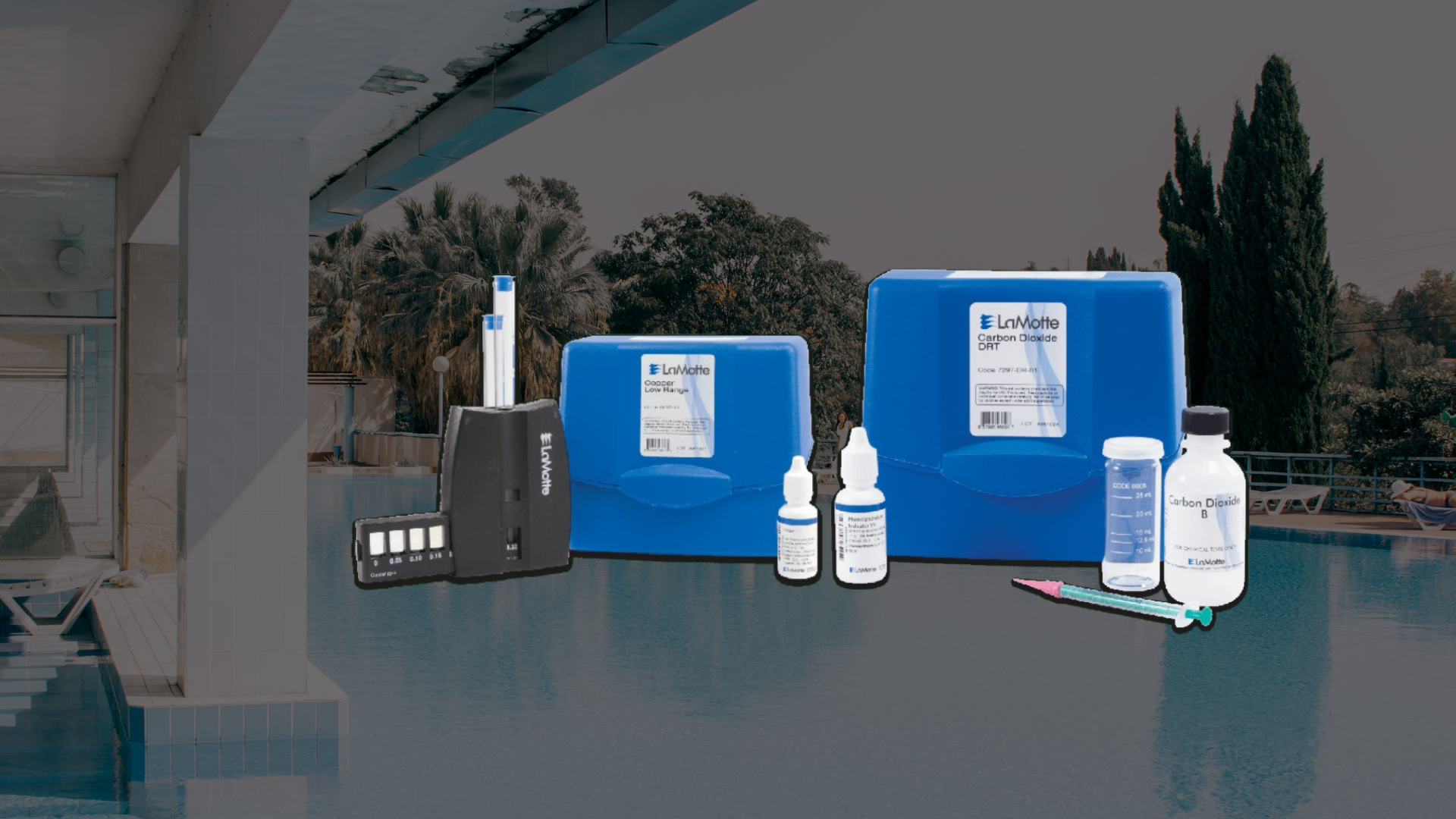
Copper, for example, can enter water through source water, corrosion of copper-containing components or the use of copper-based algaecides. LaMotte offers copper testing methods covering different concentration ranges; its Low Range Copper Test Kit, for example, measures 0.05–1.0 ppm copper.
Carbon dioxide is another parameter that can be relevant in specialised water-treatment and water-quality applications, particularly when understanding the relationship between dissolved gases, pH and alkalinity.
The important principle is simple: test the parameter that can explain the problem you are seeing.
Copper in Pool Water: Why Should You Test It?
Copper is not normally the primary sanitiser in conventional swimming pools, but elevated copper concentrations can create maintenance concerns.
Copper can originate from:
- Copper-containing algaecides
- Corrosion of copper plumbing or heat-exchange components
- Source water
- Incorrectly balanced water chemistry
When copper accumulates, it can contribute to surface staining and discolouration, particularly when water chemistry changes.
This is why a copper test kit for pools can be valuable when investigating unexplained staining or metal-related water-quality issues.
Rather than adding more chemicals based on appearance alone, testing provides measurable evidence of whether copper is actually present and at what concentration.
Choosing a Copper Test Kit for Pools
Not every copper test is designed for the same concentration range.
For example, LaMotte’s Low Range Copper Test Kit uses a colorimetric method with a range from 0.05 to 1.0 ppm Cu and provides eight colour standards. The kit is designed for 50 tests.
LaMotte also offers an Insta-TEST® Copper and Iron Test Strip Kit, with copper measurements from 0 to 3.0 ppm, providing a different approach for routine screening.
The appropriate copper test kit for pools therefore depends on the expected concentration, required sensitivity and testing workflow.
Where Does Carbon Dioxide Fit Into Water Testing?
Carbon dioxide is naturally involved in the carbonate system of water.
Dissolved carbon dioxide interacts with water to form carbonic acid, which participates in the equilibrium between carbon dioxide, bicarbonate and carbonate. This chemistry is closely connected to pH and alkalinity.
Because of this relationship, carbon dioxide measurement can be useful in applications where understanding water chemistry requires more than a simple pH reading.
LaMotte Pacific’s Carbon Dioxide Test Kit is part of its broader range of single-parameter analytical solutions. The company’s instructions and manuals library includes the Carbon Dioxide Test Kit 7297-DR-01, demonstrating the availability of dedicated testing procedures for this parameter.
This illustrates an important point about professional water analysis: a pH measurement tells you what the water’s pH is, but additional testing can help explain why the chemistry is behaving the way it is.
Don’t Ignore the Basics: Chlorine Testing Still Matters
While copper and carbon dioxide may require specialised testing, chlorine remains central to swimming pool water management.
The CDC recommends maintaining pool pH between 7.0 and 7.8 and routinely checking disinfectant and pH levels.
Accurate chlorine testing depends heavily on technique. When following LaMotte chlorine test kit instructions, users should pay attention to sample volume, reagent quantity, mixing, reaction time and result interpretation.
Poor technique can introduce unnecessary variation into otherwise reliable testing methods. Guidance on swimming-pool water testing similarly emphasises accurate reagent measurement, observing time and temperature requirements, maintaining clean equipment and using appropriate reagents.
This is why professional testing is not simply about owning a kit. The procedure is part of the measurement.
Building a More Complete Pool Testing Strategy
A practical testing strategy can be divided into two levels.
| Testing Approach |
What to Check |
When It Matters |
| Everyday Check |
Free & total chlorine, pH |
Routine water balance and sanitisation |
| Water Balance |
Total alkalinity, calcium hardness, cyanuric acid |
Maintaining stable pool chemistry |
| Stain Investigation |
Copper, iron |
Unusual staining or suspected metal contamination |
| Algae Investigation |
Phosphate |
Assessing nutrient availability and algae-management strategies |
| Specialised Analysis |
Carbon dioxide |
Investigating specific or unusual water-chemistry issues |
| Targeted Testing |
Select only relevant parameters |
Avoiding unnecessary tests while identifying the cause of water-quality problems |
This approach prevents unnecessary testing while ensuring that unusual water-quality problems can be investigated using measurable data.
Make Pool Water Testing More Data-Driven
The goal of a LaMotte water test kit is not simply to produce a colour change or numerical reading. It is to provide information that supports a better maintenance decision.
A chlorine test can tell you whether sanitiser levels require attention. A copper test can help investigate metal-related problems. A carbon dioxide test can provide additional insight into specialised water chemistry.
By combining routine monitoring with targeted analysis, pool professionals can move from reactive treatment to evidence-based water management.
LaMotte Pacific’s range of testing solutions provides options for both everyday pool chemistry and specialised water-quality investigations, helping operators select the appropriate analytical method for the problem at hand.
Frequently Asked Questions
1. Why would I need a copper test kit for pools?
A copper test kit for pools can help investigate elevated copper concentrations associated with source water, corrosion or copper-based algaecides. Testing can be particularly useful when unexplained staining or discolouration occurs.
2. What copper concentration can the LaMotte Low Range Copper Test Kit measure?
The Low Range Copper Test Kit measures copper from 0.05 to 1.0 ppm, using eight colour standards. It provides enough reagents for 50 tests.
3. Why is carbon dioxide testing useful?
Carbon dioxide is part of the carbonate chemistry of water and is connected to pH and alkalinity. Dedicated carbon dioxide testing can therefore provide additional information in specialised water-quality investigations.
4. Are LaMotte chlorine test kit instructions important?
Yes. Correct sample volume, reagent quantities, reaction time and interpretation are essential for consistent results. Following the specific LaMotte chlorine test kit instructions supplied with the applicable kit helps minimise testing variation.
5. What should a LaMotte water test kit measure?
The appropriate kit depends on the application. Routine pool testing commonly includes chlorine, pH, alkalinity and hardness, while specialised testing may include copper, iron, carbon dioxide or other parameters.
6. Can copper be tested with test strips?
Yes. LaMotte’s Insta-TEST® Copper and Iron Test Strip Kit measures copper from 0 to 3.0 ppm and provides a convenient screening method.
For Further Enquiry Contact: sales@lamottepacific.com